I had been hearing a lot about the Byzantine culture, era and religion, ever since arriving in Greece.
 |
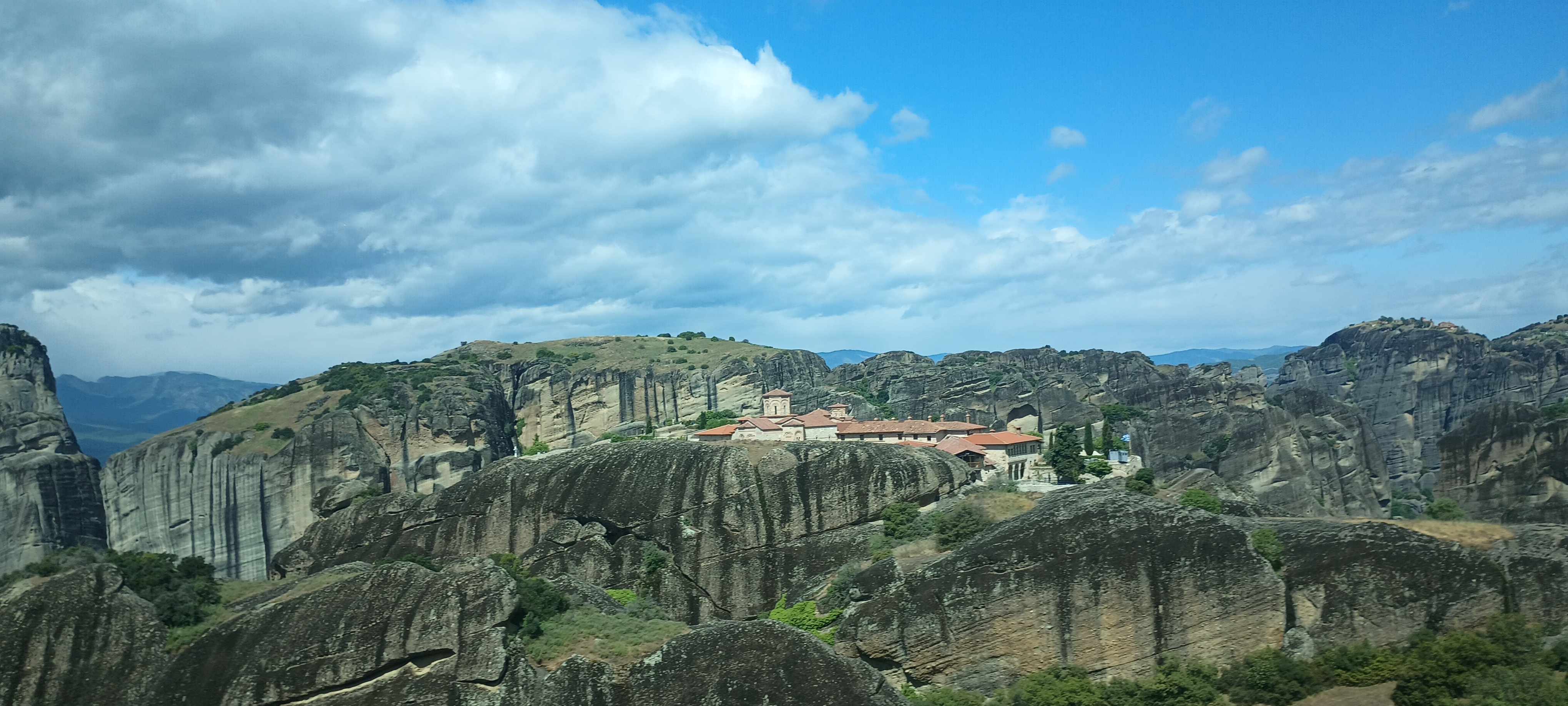
| Monasteries on top of the highest mountains in the holy city of Meteora. |
In fact, after we left Athens and arrived in Thessaloniki, we were informed by the audio guide on a hop on hop off bus, that this is the place in Greece where the Byzantine culture is still strong.
Although I tried to research it on line to try to find out the significance of that culture, I just could not get real clarity until going to the Byzantine Museum there.
Only then did the fog clear.😊
No wonder Museums are some of my favorite places!
As I now understand it, the Byzantine Era and culture developed under the influence of the Greek Eastern Orthodox Church from the 4 th-12th centuries.
The Empire was partially destroyed and the culture watered down between the 13-14 centuries, when the Ottoman empire spread its Muslim influence throughout Greece.

As the Muslims invaders advanced into the country, Orthodox monks and nuns retreated higher into the mountains of Meteora to build monasteries where they could find peace and solitude to practice their religion.
That is why that area is now dubbed a holy city and recognized as a UNESCO world heritage site.
For more on Meteora, see;
https://joan-myviews.blogspot.com/2024/04/the-holy-meteora.html?m=1
The museum now showcases the development of both the religion and culture up to the 14th century, when the Empire disintegrated.
 |
 |
| Fixtures at an early Orthodox church. |
 |
 |
| Early altars, called Ambo |

 |
| It gets progressively more modern. |

I have always seen pots of all sizes and shapes displayed in many museums and had labored under the impression that they were all used for some kind of storage, but I learned at this museum, that babies and small children were often buried in clay pots.
Further, according to the Byzantine, they were the ones that started the practice of having graveyards built within church property, as before these were located outside city walls.
It is also now clear that the Byzantine era influenced a great deal of what you read in the New Testament.
 |
| Artifacts found in church ruins. |


 |
| Actual tombs excavated from early Church ruins. |


My greatest fascination was however with pre and post Byzantine art, for every piece in the museum showed holy apostles, saints and religious people as having dark skin and thick hair during their rule.


 |
| A garment worn by an early Church official. |


Such early religious people only started to be depicted with the light skin and European features, when the Roman Christian Church became dominant.

That's an early part of history that has been hidden, so even in black countries, Jesus and his followers were suddenly depicted as being white with blue eyes.
That is totally out of character for the region in which they were born and lived and the Byzantine tradition.
That partly explained for me why the Greeks are considered the least racist Europeans!
Yup, remember, it's always the victors who write history!

Easter in the Greek Orthodox tradition starts May 5th and lasts a week.
From we were there in late April, lights started to be installed in Thessaloniki to prepare for the holiday.
For me personally, this trek to Greece has been such an eye opener in so many ways!