Showing posts with label babies. Show all posts

Thursday, May 29, 2025

A site to behold! ๐Ÿ™

I took the train (all by myself๐Ÿ˜Š) on what should have been a 5 hour trip to Anuradhapura. For some reason the trip took close to 7 hours, but I am not complaining.

It's around 127 miles north of Colombo and is an UNESCO World ๐ŸŒ Heritage Site, both for it's religious and archeological importance.

I have visited many religious sites all over the world, from Vatican, (christian), Istanbul (Muslim) Bangkok (Buddhist) etc, but I don't think I have ever seen anything as spectacular as this.

Had to buy a shawl to cover my white sleeveless top. No such requirement at the Golden Temple in Dambulla. Different towns, different cultures.

And when you consider that most buildings in Anuradhapura are over 2500 years old, it makes it more amazing.

My first image of one of the Temples. I arrived at night.

According to Wikipedia:

 "Anuradhapura is the cradle of the Hydraulic Sinhalese civilisation, Theravada Buddhism, and the longest-serving ancient capital of Sri Lanka that has survived for 1500 years. 

The networks of ancient temples and monasteries now cover over 100 square kilometers (40 square miles) of area of the city today.

The founding of the city is around 437 BCE, but the site has been inhabited for much longer, making it a major human settlement on the island for almost three millennia and one of the oldest continuously occupied cities in Asia, a cradle of Sinhalese civilization.

It's also longest-serving ancient capital of Sri Lanka  and has survived for 1500 years.

The city was mostly destroyed and largely deserted after 993 CE, with the Chola invasion from South India.[2] Although several attempts were made by later Sinhalese kings to return the capital to Anuradhapura, it was not reestablished as a major population centre of the island until the British colonial era in the 19th century CE. Despite its decline as a political centre, Anuradhapura remained a vital pilgrimage site for Buddhists throughout the medieval period and continues to be a significant spiritual destination today.[3][4] The modern revival of Anuradhapura began in the 1870s under British colonial rule, with infrastructure and urban planning initiatives aimed at supporting administration and accommodating pilgrims.[5] The contemporary city, much of which was moved during the mid-20th century to preserve the site of the ancient capital, is a major road junction of northern Sri Lanka and lies along a railway line. The city is the headquarters of Sri Lanka's archeological survey, and tourism is a significant factor in its economy."


(I was all decked out in my white sleeveless blouse to take the tour but had to cover my "mawga" arms. Also, I bought the bottom to enter a temple in Thailand but had to pin the split down to the knee, as too much leg was showing.๐Ÿฅด

Not complaining, just pointing out that different areas have different cultures in the same way even siblings can differ in their beliefs and practices.)

The young caretaker at Airbnb I stayed, gave me these petals. I thought they were for my room so left them at home.

I should have taken them to one of the shrines to use them to pay tribute to Lord Buddha.

 I live and learn.๐Ÿซข.


Adherents putting gifts all around Lord Buddha's reclining image. They even bring cooked food!๐Ÿค”.


Drummers leading some worshipers.

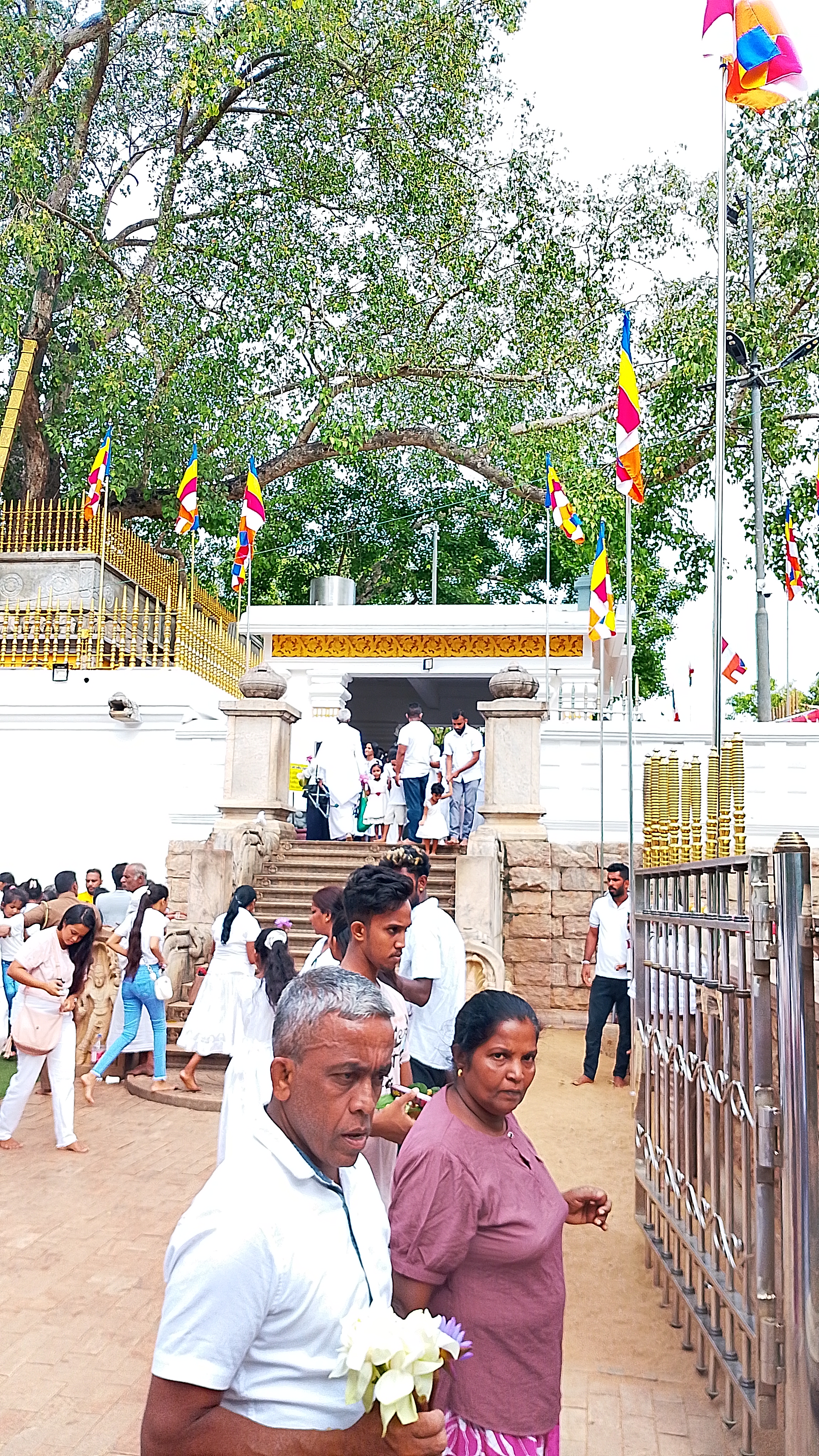
Loads of flower blossoms are given to worshipers to put on the altars at the Temples and Pagoda at the holy site.

The bottom of the main temples are wrapped with the Buddhist flag. It's quite a ritual performed by the monks.


While some of us are busy debating whether Buddhism is a religion or a way of life, to the thousands I saw there in May 2025, it is definitely a religion

They came to meditate, pray, pay homage to  Lord Buddha, give him gifts and get blessings.

And as part of this ritual, they bring (cooked) food, flowers and gifts for his monks and the smell of incense is all over, pleasant and calming


To me it was kind of surreal, especially since I have never witnessed such a crowd at a religious site a before.


Once a baby becomes 3 months old, he/ she is taken to a Temple to be blessed.


This is a man-made lake near the main Temples. Some adherents go there to cool off after a day of meditation and prayer.

One of the large rooms where incense are burned.

Despite the thousands moving through the large area, it is spotless as, workers ( volunteers?) are all around always cleaning up.

I tell you, the beauty of the artistry, carvings, sculptures is really overwhelming.

I have also been learning about the unlimited generosity of ardent Buddhists, but I was still surprised to see the truckloads of foods and fruits that local farmers brought there to give away free to those who were at the Temples๐Ÿ™.

As I passed through one exit, I got a hand of ripe, bumpy bananas aka chiney banana, my absolute favorite.๐Ÿ˜Š

 I was so tired after walking miles just to see what was taking place at the religious sites that I didn't even bother to visit the ruins.


They said this lady was a Hindu priestess who was performing some kind of a healing ritual there! 

Links

https://youtu.be/3mOwnITV3A0?si=joM-RF96EtluXgg3

https://youtu.be/80AuEBrPUsA?si=LxbG3X63mb_rLqHq


Thursday, March 6, 2025

Out of Africa

 Religion and slavery

If you are a descendant of African slaves, you shouldn’t visit Ghana without going to Cape Coast to see for yourself, some of the atrocities of the Atlantic slave trade.

This horrid place is 135km journey from Accra, the capital.

There you find Elmina Town on the Atlantic Ocean. That is where the shipment of captured and tortured slaves took place. 

Today it is a bustling fishing village to which traders come to from near and far to get supplies.

However, still visible and intimidating is a solid building on the hill overlooking the town. 

This was the army barracks which housed the well-armed soldiers who guarded the slave port, the fort and castle in which the human cargo were held.

In short, that is where the most heart-wrenching example of 'man's inhumanity to man' and the evils of Christianity, still stand fully exposed.

 It is also now an UNESCO heritage site.

This is Elmina Castle where the slaves were held, traded and tortured. The second floor had a chapel and religious quarters.

This castle was erected in 1482 by the Portuguese as a normal trading center until they realized how much more lucrative it was to trade in humans rather than products.

The Dutch seized the castle and fort from the Portuguese in 1637 and like their predecessors, used the promise of milk and honey through Christianity, to fool native chiefs and lull them into complacency while they continued the lucrative slave trade across the Atlantic.

In the mid 1600’s, the British who had become the most successful slave-trading nation, took over the castle and used it as their main slave trading post until 1807.

Between 1650 and 1860, it is estimated that approximately 10 and 15 million Africans were transported, often more dead than alive, to the colonies in the Caribbean, North and South America and to other countries.

Although the British claimed they had officially abolished slavery in 1837, their traders either outrightly or covertly, continued the trade or owned most of the ships that took millions more of captured Africans to their doom.

I often heard our Ghanaian guide's voice crack with emotion as he related some of the atrocities our ancestors experienced there.

What was especially disgusting for me was seeing the Biblical quotes all over the chapel and the space where the religious leaders slept. 

This is right above where slaves were tortured and kept chained in dark dungeons on cold bare floors.

On trading days, the slaves would be paraded naked below, as the buyers inspected them through the peep hole on the chapel floor and choose the ones they wanted.

Once the deal was done, the slave would then be branded with hot irons, with the names of their new owner.

Female slaves were also held naked and chained too. Sometimes they never received any food for 72 hours and all bathroom activities happened right there.

As the traders did not travel with their women, when they wanted sex, they would take one or a few females outside and wash them off. The water used to bathe them came from an underground drainage which they said they could never use themselves, as it was toxic.

Females who resisted were brutally punished. Those who got pregnant would be taken away to the town to deliver and brought back to the dungeon immediately.

Their children were never seen by them.

The dungeon to which rebellious slaves were taken had no ventilation, and the slaves were left there to starve to death. Their bodies were then dumped in the ocean.

The door of no return which led out to the ocean, was through which the slaves were taken out to the shore to board to small canoes which took them to the large slave ships anchored offshore.

Quite frankly, after seeing it all, I was shocked at how much Ghanaians are still into Christianity today despite these stark reminders in their midst of how evil it all is! (25% of Ghanaians are Muslim, the rest are Christian.)

 I have never seen more posters and billboards vying for people's souls anywhere else in the world than on this road from Accra to Cape Castle!

I estimated that at least 70% of all the roadside ads were about church activities, a small number advertised funerals and memorials, and the rest were commercial.

Jamaica has just as many actual churches as they do (proportionate to size and population of course) but they spend a lot more money by far on advertising religion than we do.

On a lighter note, whereas in Jamaica, there is usually a bar or two beside each church, I saw very few bars along the road to Cape Coast or anywhere else in general.

It seems Ghanaians concentrate on one spirit only.