Showing posts with label Portuguese. Show all posts

Saturday, July 5, 2025

A true friend for lifeπŸ™.

The Miracle of Friendship by Mayo Angelo.

A Miracle called friendship Dwells within the heart

You don't know how it happens Or when it gets it's start

But the happiness it brings you, Always gives a special lift

Then you realize that friendship Is one of God's most precious gifts!

It was my special blessing and precious gift from God to have had Ann Marie Hinds as a friend, for as I often tell everyone, she virtually saved my life.

So while her death from her point of view was a great relief, for me, her friends and family, it's a great loss. 

 For if there was ever an irreplaceable human being, it was my late Guyanese sister Ann-Marie Hinds nee Defreitas.

I first met Ann Marie around thirty five years ago when she and her young children accompanied her then husband Bill, who was transferred from Guyana to Jamaica, to head a division of the corporate office of the Canadian Imperial Bank of Commerce. (CIBC).

Ann Marie with one of her twin boys, Gino and I in November 2024.

 They had three very young children (including twin boys) but when the British High Commission in Jamaica needed someone who spoke English and Portuguese urgently to fulfill a temporary assignment,  they prevailed on her to assist them as she had lived for years in Brazil.

 However what should have been a temporary role there soon evolved into permanent employment and she spent quite a few years working there and living very nearby.

With Shadrach (partly hidden) on same occasion.

The Miracle of her importance to our lives was played out in July 1995 when Thor, my only son, who had just fathered his son Shadrach, was murdered.

If you have never trod that path, the effect of such an occurrence can never be understood.

For during that agonizing period of tragedy and shock, neither Michelle (Shadrach mom) nor I were capable of doing anything.

 And I mean anything, much less tending to the needs of a six week old baby.

But it was during period that God's special gift to us stepped in. For every afternoon after work, Ann Marie would drive past her own home without stopping, to head straight to our home, to bathe, feed and tend to our new born.

 I don't recall how many days or weeks she continued that absolutely essential act of mercy and goodness, but the blessings of having such a friend when we most needed it, can never be forgotten or repaid.

We were so happy to see her on Thanksgiving Day 2024.

As the years went by and some memories of that tragedy faded, our friendship grew stronger and when she returned to Guyana, I went and spent three wonderful weeks there with her.

But I have never been able to come even close to repaying her for the critical, life-saving role she played in our lives when we needed it most.

It was therefore especially devastating when around eighteen months ago, she visited Florida and during her time here, got ill and and was diagnosed with cancer. 

Guyana has a very advanced cancer treatment center, so she returned home and had to have two operations and undergo painful and debilitating bouts of chemotherapy.

 I was however overjoyed when she called in November 2024 to say she was feeling a little better, so was coming to Florida to again see her family and spend a few weeks with me.

It was during that visit that she started to feel unbearable pain and when we went to the ER, they discovered that the evil disease had gone into her liver. 

But the woman of courage that Ann Marie was, decided to accept her pending death, for as far as she was concerned, the treatment was worse than the disease.

(L) granddaughter Rayane, (R) daughter Anjeta.

If you have ever felt you owed someone your life but are unable to do anything to help them in their time of suffering, you may begin to understand how inadequate and useless I have felt during the months of her intensive pain and suffering.

For the agonizing pain she bravely confronted for months on end, was excruciating and heart-wrenching.

Yes, now her pain is finally gone but the impact she had on our lives will forever live on in our hearts.


Till we meet again, walk good mi fren.πŸ˜₯.

Tuesday, June 3, 2025

Galle/ Dutch Fort.

I thought my last weekend in Sri Lanka would be a total washout, as it started to raining non-stop from Thursday.

 We planned to go to Galle,  in southwest Sri Lanka, about 71 miles from Colombo.

We left Colombo in the pouring rain early Friday morning and it rained all the way to our destination.

Then ta-da, as we arrived, it stopped raining and has been great ever since.😊.

Latsane, Joan, Sharlene, Damith 

My hosts Damith/Sharlene and I all stayed in nice little hotel in town called Blue Heaven. Later we had a grand time hanging out at Galle Fort with their friend Latsane.

This Fort, built by the Portuguese in 1588, is on the Indian Ocean.

In 1649 it was fortified by the Dutch and is today an important architectural heritage site controlled by UNESCO.


The entire town and surroundings are growing rapidly, partly due to the influx of tourists.

However 21 years ago, much of the town was flattened by the tsunami which devasted much of south east Asia.


Thousands of people were swept away and killed, 500 just in the transport center in town alone! 

Naturally the ruins were also damaged but you
wouldn't believe it looking at the surroundings today.


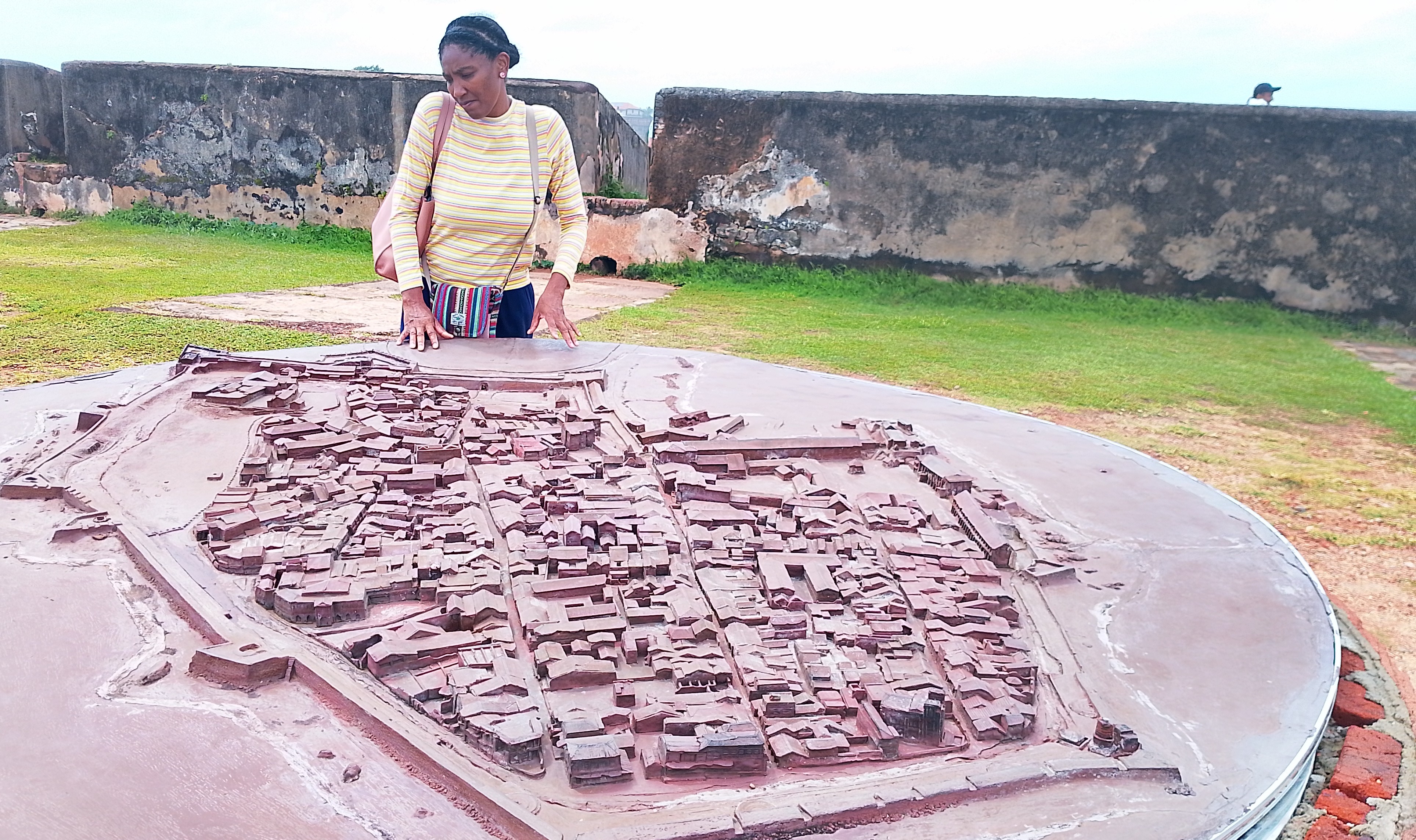
A replica of the original small town.


Most of the archeological site remains in pretty good condition, despite having been badly damaged in 2004.

Miniature, showing the original design of the city.


A huge Mosque near the ruins. As it was Friday, many Muslims were busy in the area.


The very angry Indian Ocean.


Like much of Sri Lanka, this city is home to religious adherents from all the major religions, but the dominance of Buddhism which is so obvious in other areas, was not visible.

A Buddhist temple on the hill quite a distance away. I could also see a huge, old Christian church in town, from the fort.
The roof of the solid ammunition storage building.
A Muslim on her way to the Mosque ahead.
A coconut tree grows out of the large granite rock heap offshore.

These ladies in beautiful saris are teachers at the International School. The saris are their uniform.


A small cafe has been set up in the midst of the ruins.

Tourism is now Sri Lanka's second most important industry, so both local people and visitors flock this area. 

This is a recognized UNESCO world heritage site and every time I visit a place like this, I wonder why we are joking around with our sunken city, Port Royal?

 Such a damn shame.😑

Pic of the very angry Indian Ocean below!

This lovely house on the Ocean was badly damaged by the tsunami, but they fixed it up nicely.
That's where we stayed overnight before heading back to Colombo.


Young people challenging the rough surf on their boards.


There is a statue of Buddha on the hill overlooking the town of Galle.

The Indian Ocean is so rough and sounds so fierce, it's kinda scary.


The sand looks nice though.

Among Damith's friends that we had drinks with on Friday night was Dr Ruwan who served as coroner in Jamaica for 3 years.

Then to my surprise, on returning to Colombo I discovered that my wonderful hosts Sharlene and Damith, had organized a goodbye dinner for me with some of their young friends.

L-r. Charaka, his wife Tara, Dr. Damith, and Ganga.

It's been an overwhelming three weeks as there is so much to see and do in that very big island. And the Sri Lankan people are so warm and generous.

It's really true that time flies when you having fun.

And boy, did I ever have fun😊.

_________________________________________

Update. The rains that started on Thursday night turned into quite a storm with high winds later in the night. It damaged the roof of 
Latsans parents home in Galle. 
He is a contractor though so had already repaired it by midday Saturday when we saw him again. πŸ‘

That same storm however killed a family of seven in another area close by. Their home  collapsed on them.πŸ₯Ί

It's the beginning of the monsoon season in Sri Lanka and the weather seems to be intensifying now.

Tuesday, June 20, 2023

Religion and slavery

Yesterday was our day to face the atrocities of the Atlantic slave trade. 

For this, we undertook the 135km journey from Accra to Cape Coast.


The roads are relatively good and we had an excellent driver in Livingston, who doubles as my informant on everything cultural, tribal and historical.😊.

He is well rounded.

Livingston is extremely knowledgeable.

Ghanaians, I find in the main, to be very polite and capable drivers and they are prevented from speeding too much due to the proliferation of speed bumps, (aka. sleeping policemen) large and small.

 Elmina Town today is a bustling fishing village, to which traders come to from near and far to get supplies.


The building on the hill is where the army barracks were for those who guarded the slaves and the fort at Elmina. In front, people hanging out at the bridge watching fishing boats come and go.

The market is below.

A long sea wall keeps out the water from the angry Atlantic Ocean.


The castle bears the memories of 'man's inhumanity to man' and the evils of Christianity.

Biblical quote in chapel above where slaves were tortured.

It was first erected in 1482 by the Portuguese as a trading center until they realized how much more lucrative it was to trade in humans rather than goods.


It is today a UNESCO World Heritage Site.

The Dutch seized the castle and fort from the Portuguese in 1637 and like their predecessors, used the promise of milk and honey through Christianity, to fool native chiefs and lull them into complacency while they continued the lucrative slave trade across the Atlantic, there.


Britain was one of the most successful slave-trading countries. Together with Portugal, the two countries accounted for about 70% of all Africans transported to the Americas.


Britain was the most dominant between 1640 and 1807 when  it is estimated that Britain transported 3.1 million Africans (of whom 2.7 million arrived) to the British colonies in the Caribbean, North and South America and to other countries.

The British took over Elmina Castle and the fort in 1837 after they claimed they had officially officially abolished slavery In 1807. However their traders either outrightly continued the trade or owned most of the ships that took millions of captured Africans to their doom.

You could often hear our guide's voice crack with emotion as he related some of the atrocities our ancestors experienced.

 He reminded me a lot of our guide at Robben island where Mandela had been imprisoned 😑.


Slaves were kept on the ground floor of the castle. The second floor was a chapel and where religious leaders lived and the third floor was the governor's residence.

Taking a break from the heartbreaking stories 


This is a museum today but it was also a chapel on the second floor. On the ground floor slaves would be paraded and buyers would inspect them through the peep hole on the chapel floor and choose the ones they wanted.

They would then be branded with hot irons bearing the names of their new owner.

The passage leading to a dungeon

This is where female slaves were held naked and chained. Sometimes they never received any food for 72 hours and all bathroom activities happened right there 😑.
The traders did not bring women so when they wanted sex, they would take one ore a few out and wash them off. The water used to bathe them came from an underground drainage which the Dutch said they could never use themselves, as it was toxic.

Those females who resisted were brutally punished.

 Those who got pregnant would be taken away to deliver and brought back to the dungeon immediately.

Their children were never seen by them.


The door of no return through which slaves were transported to small canoes. The canoes took them to the large slave ships anchored offshore.

The dungeon to which rebellious slaves were taken. It had no ventilation and they were starved to death, then their bodies dumped in the ocean.

One of the smaller religious billboards on the roadside.

I am shocked at how much Ghanaians are into Christianity today despite this stark reminders in their midst of how evil it was! (25% of Ghanians are Muslim, the rest are christian.)

This Methodist church was built in 1900.

I have never seen more posters and billboards vying for people's souls anywhere else in the world as on this road from Accra to Cape Castle. For, I dear say, at least 70% of the roadside ads were about church activities, a small number advertised funerals and memorials and the rest were commercial.

 I conclude therefore that Ghanians worship one spirit only!😁


Jamaica has just as many actual church buildings as they do (proportionate to size and population of course) but whereas in Jamaica, there is a bar beside each church (for the men?)😚, I saw very few bars along the road to Cape Coast.