Monday, June 5, 2017

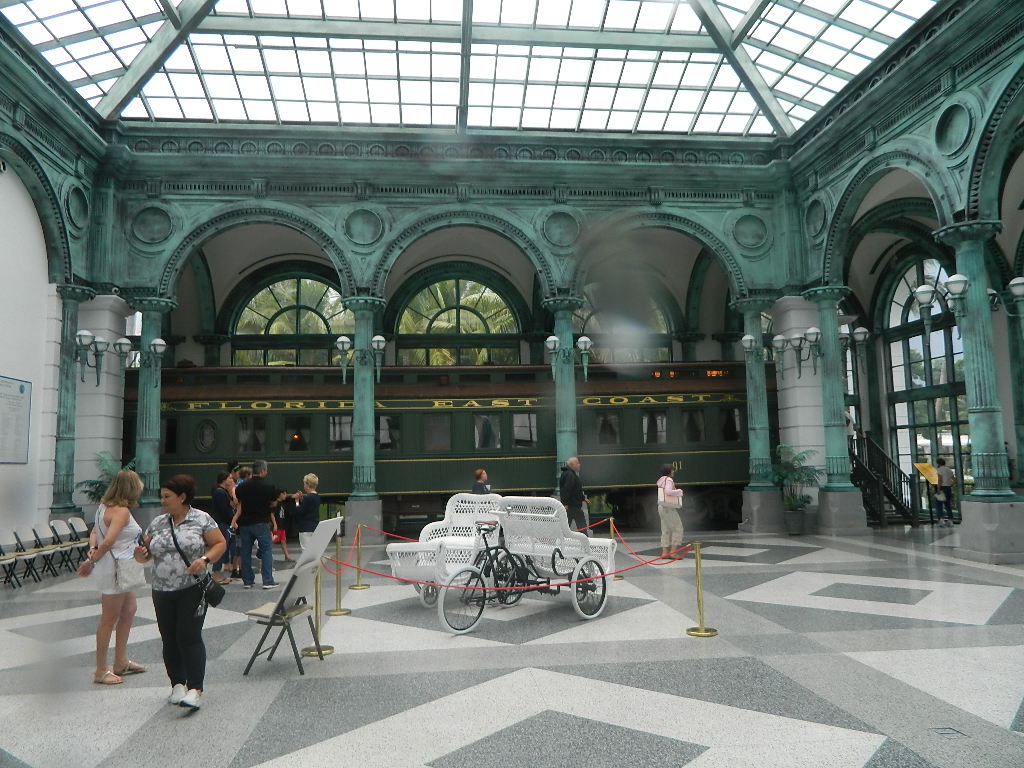
Flagler Mansion-Lifestyle of the rich and famous


It's always good to see how the really rich and famous live (d) and a good place to get a taste is at the Flagler Museum, Palm Beach in Florida.


All sorts of interesting furnishing
Flagler, who was one of the founders of Standard Oil, built and elaborately furnished this 75 room mansion in 1902, as a winter retreat.

It was later donated by his granddaughter to the historical society as a museum.

A section of the 5000 sq ft reception area
I really love the structure, view, furnishings and the fact that he even had his own rail car with sleeping area, dining room bathroom and kitchen.

The reception hall too

Beautiful private rail car
 is out of this world, all 5000 square feet of it.

Yup, I love to look at these luxurious mansions but to tell the truth I wouldn't want to live in one. (with or without ghosts!)

Today, it serves the most appropriate function, that is as a museum.

Worth a visit in my view though.
Dining car

Sunday, October 16, 2016

Bullhead Mountain, dead center of the island

This marker was installed to signify the peak as being dead  centre of the island 
Isn't it fascinating that dead centre of the beautiful island of Jamaica, stands a mountain range from which you can get a fantastic view of sections of the parishes of Clarendon, St. Ann, St. Mary and St. Catherine? Well right in the centre of that peak, you will find the marker confirming this fact.

That is the Bullhead Mountain which is situated in the parish of  Clarendon, the third largest parish in Jamaica.

The fabulous view of the scenic plains and surrounding hills
This important landmark is also the source of\Jamaica's longest river, the Rio Minho which runs from the range and empties out at Portland Point, after running a distance of  92 km ( 57.7 miles) providing life sustaining water to irrigate the Clarendon plains for thousands of farmers.

Magnificent pine trees abound
The range which consists of 220.6 hectares (545 acres) is controlled by the Jamaican Forrest Department and peaks at 547 metres (3600 feet) above sea level. As it is the forestry department that controls it, most of the area is covered in pine and bamboo trees which provides excellent shade but several species of ferns grow wild and provide a soft cushion all along the hiking trails.

While this area is unknown to most Jamaicans, the people of Clarendon have for years been using it as a major outdoor centre especially during the Easter holidays when, they trek there in droves to enjoy the wonderful scenery or simply hang out.
Fun and Thrills hikers

The first time I head about Bullhead Mountain, I thought I heard it had a beautiful waterfall and being very addicted to water, quickly  encouraged friends to accompany me on a hike there. We got ourselves a guide from nearby Thompson Town and asked him up front if he knew where the waterfall was and although he replied in the negative, he assured us that he could find it. Well we spent an entire day from about 10 am to around 4 pm hiking and dying to cool off but alas, there was no waterfall  to be found. I subsequently heard about the local folk lore that indicated that there is a mysterious waterball hidden somewhere in the range which will one day burst and wipe the entire parish of Clarendon from the face of the earth! That I heard many decades ago but have not fear, its just a duppy story!
The entrance to the park

More recently though, I went on another trek to that mountain with my regular group Fun and Thrills.

This was a properly organised outing overseen by environmentalist Nicole Brown who arranged with members of Northern Rio Minho Forrestry Management group, an environmentally active community group, to give us a proper tour.

Young Norris
Naturally, as Bullhead is dead centre of the island, there are several ways to get there. This time we opted to drive from May Pen to Red Hills via Pumpkin to Orange River road. It was near the park that we met there that we met a most pleasant young man, Norris Newman on his way to the river to get water.

When the guides joined us, my first question to the guides was "Are there any waterfalls here?" They assured me there was but after many hours of walking, when we got there, because we were in the midst of a severe drought, what we saw was a mere trickle.

This was however the occasion on which really got comprehensive information about this mid-island wonderful park. For example, we learnt that the original name was name of the mountain was Santa Marian, named after an indigenous plant found there. The name was however changed by the British to Bullhead, as it is said that the peak looks like a bull's head
when seen from out at sea and it provided an excellent navigation tool for sailors in the olden days.

Scenic views from every angle
We also learnt that the famous Maroon warrior Cudjoe, hid out there for a while after killing his first British aggressor in nearby Colonel's ridge which lies to the south of the range. As a result of the greart warrior and members of his troops hiding out there for a while, there are many descendants of the Maroons in the area, although we were told that they do not keep up the traditions as do their relatives in places like Scotts Hall and Accompong.

Nope, we still haven't seen a good waterfall at bullhead mountain but it is still a fabulous place to visit and lyme.


Thursday, March 17, 2016

DISCUSSING MY AUTOBIOGRAPHY 'LOOKING BACK, The struggle to preserve our freedoms

DISCUSSING THE BOOK ON POWER 106 WITH FELLOW TALK SHOW HOST CLIFF HUGHES;

https://www.facebook.com/575154275969964/videos/625129860972405/?pnref=story

Wednesday, March 2, 2016

Moore Town

According to the Jamaica National Heritage Trust, ".... in 1739 Cudjoe, Nanny's brother, signed a peace treaty with the British. The Maroons thereby became the first group of blacks to succeed in gaining their freedom and having that freedom officially recognized. 

Nanny, at first refused to sign a treaty with the British but eventually agreed to a truce. Nanny's Maroons, after the truce, divided themselves into two groups one of which went with her Brother Quako to Crawford Town and the other group followed Nanny to a new settlement, New Nanny Town, now called Moore Town.
Posing with Colonel Sterling,

In each Maroon settlement was a white Superintendent whose job it was to maintain good relations between the Maroons and the British. The success of settlements like Moore Town depended to a large extent on the diplomatic skill of the Superintendent and Moore Town was fortunate in obtaining good ones. 

The most famous of these was Lt. George Fuller, an Englishman, who became the Acting Barracks's master, and later Superintendent at Moore Town between 1809 and 1823. He also started the Fuller family through marriage with a Maroon girl."

Moore Town is today governed by Colonel Sterling who has been in that position for 20 years.

 According to him, the maroons do not have set elections but whenever the residents want a change of leadership, they have their means of asking for a change or letting their dissatisfaction with the current leadership known.

Under his leadership are the villages of ;  Kent, Brown's Field ,  Seaman's Valley, Moore Town, Ginger Hill, Comfort Castle and Millbank with a population of around 10,000 maroons. They have their own regulations and their council deals with all illegal activities except murder which falls in the jurisdiction of the Jamaican state. One way they maintain a low crime rate is that when strangers come into any of their villages, guides immediately approach them to see what they want and if necessary take them immediately to the Colonel.

What I was especially impressed about is how proud they are of their culture and how it is highlighted everywhere. In fact, I had the pleasure of meeting two very nice young men there. They were Kevin Patterson and Rayon Sterling aka. RJ who is a grandnephew of the Colonel. They proudly informed me that they were members of the junior cultural group and their traditions are kept going strong as from an early age the kids are exposed to every aspect of maroon culture in their schools.


Kevin and RJ

This recent trek to Moore Town took place on February 28, 2016 when some 80 persons journeyed to the settlement under the aegis of Fun and Thrills.

Some super fit troupers namely Maurice, Omar, Julian, Derval and Johann rode all the way from Kingston and back (returning home 8 pm I hear!), amazingly some of them even  reached Moore Town before any of the other riders or hikers. The other troupers fell into two groups, B team riders and hikers. The riders drove to Buff Bay and cycled from there whereas the hikers, among which I was numbered, walked from Fellowship.

 As usual, it rained most of the day but that made it a great day for hiking as the steady drizzle really cooled us down. Actually it rains so much in that area that just outside of Windsor we saw a marker on the road showing possible flooding up to 7 feet. When we inquired from a farmer we saw  tending his banana plantation across the road if It had actually reached that height, he said he had never seen it but he had experienced the water rising to the 6 foot level a few years
ago when it flooded his field.

We were actually on a trek to the famous Nanny falls which falls under the jurisdiction of the Moore Town maroons.

As you enter the community, you could almost feel a difference but what really surprised me was the profusion of churches, at least four in the first 200 metres after we left the main road. While most were some form of evangelical denomination, I was interested to learn from the colonel  that the Anglican church there was the very first to have been built in the area, some 100 years before any other.

I loved the pedestrian bridge too, which crosses Wildcane River and leads to Corn Puss pass in the John Crow mountains.

The pedestrian bridge over Wildcane river mountains.


As we arrived, we headed straight to breakfast in the school, where we had pre-arranged to have a typical maroon breakfast.  However, the janga run dung was just not up to the standard of what we had been introduced to on  a previous trip to Millbank,  but I guess that like in all societies, you have good and poor cooks.

After breakfast, we anxiously set off on the 20 minute walk to Nanny Falls. The first thing that struck you on that journey was the profusion of apples strewing the ground. Such a waste when you consider how much they cost in the city. The good news though was that many of the trees had an ample supply of apples hanging fairly low down so we could pick and eat as we trekked.

As, the falls are way below the track we walked on, the maroons built steep steps go get down there and that was quite a  challenge for some people.

The falls that day were also really bursting  as apparently they had been having heavy rainfall in the area so the force far exceeded what we had seen on the exploratory trip some weeks before. In fact so fierce and cold was it that I did not go in at all but most other persons did and had a wonderful time bathing and frolicking around.

  Despite the vast number of persons who accompanied us on this trip and the logistical challenge that it must have caused for the organizers Ayatollah and Chuck, it was an wonderful, well organised fun day.

Unfortunately it did not end too well for the chief organizer Charles Williams and his twin Chully who had to drive back to Fellowship where some vehicles had been left, in the back of an open van in the pouring rain. However I am sure that once they got dry, they too felt that the day had been well worth all the discomforts.


Photos compliments of Janel James, Julian Dadag, Michelle Munroe and David Jo.

Sunday, January 17, 2016

Ride Good David/The misty Blue Mountain Range

Some of the happy hikers
I can't forget the first time I met David Linehan some years ago. He was a little Englishman, probably in his 70's who had  been in Jamaica for quite a few years. I have no idea why the conversation that day was about how we would like to die, but  his version of the perfect exit was to be shot by a jealous husband. He was on about his third marriage at the time. Not only did David have a great sense of humour but also he was addicted to cycling and impressed  us with many of his escapades including his having entered the Tour de France in his youth. After that, I saw him riding often, sometimes with others but more often by himself.

It wasn't a jealous husband who killed  David though but unforgiving cancer, but even after it was diagnosed and he was receiving treatment, I often saw him riding although he did admit that sometimes he was feeling quite weak. He however would have been overwhelmed by the send- off he received from his many friends and admirers from just about every cycling club in Kingston who gathered at Newcastle in the Blue and John Crow mountain range, to ride to Buff bay in Portland and back on Sunday 10th January, as a tribute to him. 


Ride good David.

Yes I admired David and wouldn't have minded doing a cycling stint in his honour but definitely not the 20 mile return journey back from Buff Bay for it is uphill all the way.

So I happily joined in with a few people who decided to accompany the cyclists to Newcastle and hike to Cascade Waterfall at Regale.

It was an absolutely wonderful day to hike as the hills were overcast and a gentle drizzle accompanied us most of  the way .

 When  we got to Green Hill, Chuck showed us a shortcut to the waterfall but as the path was wet and we suspected it would be slippery, we opted to stay on the road.

It was while we there discussing the options that Mikey rode up and advised us that his bike was a taxi but we declined the offer of his  services. Shortly after,  the rain started to really pour down  but while some persons jumped into the support vehicle being driven by Chris, the rest of us soldiered on.

Chuck and Miss Bunny wait on the coffee to boil
At Section it was quite an experience as we stopped at Dennis Coffee shop where you can get the total Jamaican coffee experience. For there the coffee is taken through every stage before your eyes if you are a tourist and wish to see it prepared.  That is, the beans are roasted, then beaten in a mortar and boiled on a wood fire.

Flash poses beside the mortar in which the coffee beans are beaten
It was there too that we met a colourful character who said he was called Flash.

 He had a glass of white rum in his hand (at around 9 am) and was sipping happily. When asked why he was indulging so early, he explained that he was on his way to church and since the parson  had his "owna spirit" he had to get his too.

After coffee Flash staggered along with us downhill to where his church was at Padhouse. He even sang one of his songs for us for he assured us that he was a successful entertainer but I am not sure I agree with him there!

After leaving Section the rest of us walked along the breakaway area but Charles was taking no chances and went on the new road.

I remember when we were going to Avocat the new road had not yet been constructed so we have to push our cycles along the breakaway section but it looked less scary now. I suspect it is because the bottom of the deep ravine is now fully covered by bushes so you can no longer see the dept to which the road had collapsed during the landslide which created the breakaway.

 It was an easy walk downhill from Section in weather designed for a hike in the mountains. Not much further on, we were surprised to see Chully zipping up towards us. We thought he had morphed into an outstanding rider, leaving the experts like Maurice behind, but he assured us that after it took him over an hour and a half to ride 10 miles downhill, he was not about to complete the entire journey as it would mean him getting back home too late.

Amazingly however, not too long after we saw Barry bolting up the hill and he assured us he had completed the entire journey to Buff Bay and was on his way back to Newcastle.

We eventually got to Cascade but were told that the waterfall was about another mile down, so trodded on.

 We were soon joined by a gentleman who told us he was a part-time tour guide and he sung the praises of the waterfall.  It was a really nice walk down to Regale but by the time we got there it was heavily overcast and we could barely see the falls in the hills. Our companion wanted to take us up to the falls anyway but the track he pointed out was slippery and most people were not about to face the possibility of slipping and hurting them-self on the tiny path and besides it was too cold to swim anyway. So we decided that another trip to Cascade waterfalls would have to be be organised for some time during the summer months when the water would be much warmer. (hopefully!)

Cascade waterfall on a clear day
It was a good thing we took that decision too for shortly after we piled into the support vehicle, a very heavy mist descended and at times I swear Chris never had visibility of more than about a foot.
We could barely see the waterfall because of the mist
 As it was an open back vehicle, the men were in the back and I heard them, bawling for cold as we drove along. On quite a few occasions too, vehicles that had been invisible in  the thick mist, suddenly appeared in front of us and Chris had to do a lot of reversing and maneuvering to get us back safely to Newcastle.

We then went to Cafe Blue for breakfast, about three hours after we had asked them to prepare for us, but they were most obliging and accommodated us. It was really a wonderful  morning of hiking in the scenic, healthy Blue Mountain range, now a UNESCO site. 

Tuesday, November 24, 2015

Milk River Trek


Milk River Bath as most of you would probably know, is named after the river there which provides important irrigation for the Clarendon  plains where you find mostly cane and livestock farming.

 However, the river itself is infested with crocodiles and on our way we saw some fishermen with a small canoe and when asked what they were fishing for they laughingly said "crocodiles and fish."

 However, the bath does not get its highly radioactive water from the river, but from springs under the property itself.  And radioactive it is and warm too at a consistent 90 to 95 degrees Fahrenheit throughout the year. It is also said to have high levels of magnesium, calcium, sulphate and natural chloride which is said to help alleviate pains associated with  rheumatism, arthritis, sciatica and nerve complaints. The waters, however are so radioactive that patrons are warned to stay in for no more than ten to twenty minutes at a time, and then for no more than three baths per day.


 These baths were  opened in 1794 as according to legend, a slave, owned by one Jonathan Ludford  was brutally whipped and locked away in a dungeon. Imprisoned and severely wounded, and vowing never to be a slave again, he broke out of his chains and escaped. Days later, the man returned to the estate in full health, healed of the wounds he had received only a few days before. In an effort to convince others to run away with him, he told a tale of a remarkable salty spring in which he had bathed. Everyone who saw him was amazed at his recovery, and soon, word reached the owner of the estate who had ordered him punished. Ludford himself was astounded at the recovery, and promised to grant the slave freedom if he revealed the location of the spring. The slave led a party to the location, and Ludford promptly acquired the spring and the lands around it, and started the Milk River Baths.


 Upon his death, Ludford bequeathed all the property and land to the government and people of Jamaica to benefit all who needed them.

 I have not visited those baths for around ten years as the last time I went there it was in really terrible condition with junjo growing around the edge of the baths and the rails rusty.

In September 2015, Dr. Wyckham McNeil, Minister of Tourism  announced plans to carry out a $50-million rehabilitation project to include:

* demolition and alterations;
* upgrading of the electrical and plumbing systems, ceiling and floor;
* painting and decorating; and
* replacement of leaking and damaged roof


On this trip in November 2015, I returned with my Fun and Thrills familyWhile the real athletes rode from Kingston, a bunch of us drove to Osborne Store then headed south down to Gravel Hill primary school, parked and whiked  the 8 km to the bath.  At least, most of us walked while Ruth and Lisa the young turks jogged. My yoga teacher, Dada from Ananda Marga came to hike with us. While we waitied at the school for mthe others to arrive, a young rastaman rode up[ on his bicycle and mwelcomed us, then he and Dada got into a philosophical conversation. Before we left, Dada declared  "You know I agree with a  lot of the rastafari philosophy but I dont approve of the smoking of the herb" To which his fellow debater laughingly replied "Mi a smoke fram mi barn and mi healtier dan yu".

On the easy scenic walk, we passed a nicely decorated (private I guess) area called "Milk River Park" with some interesting paintings and signs, the most interesting being the ones calling for the legalization of Obeah and the one purporting to be a drawing of our ancestors!


Despite the governments announcement in September, not much work seems to have been done yet as the only noticeable improvement I saw that the the baths were refurbished (but the rusty rails remain)  some roofing work has been done and some areas re-tiled. Hopefully the next time I return, we will really see  $50 million improvement.!~


The bath was really refreshing and invigorating and the food was great, although about 70 persons took the trip while some 20 did not indicate they were coming and arrangements had only been made for some 50 the week before. This of course created some problems for the staff but they managed.


It was really an enjoyable day all round and of course Maurice and his ride back posse did declare they were riding back. I don't know if they did but the rest of us returned to Kingston in  comfortable vehicles with some of us even rejecting the new highway to drive through Old Harbour to get some delicious jerked pork.

Photos by David Jo and Jackie.


Wednesday, November 11, 2015

Our lives begin to end the day we become silent about things that matter." Martin Luther King


It reads like a spy thriller but events written about in this intriguing book really happened in little Jamaica in the 70's where the author, now an outspoken talk show host, was forced to join other courageous, freedom loving activists in the struggle to preserve their freedoms. This was during the era when the cold war raged and Jamaica was caught up in the deadly struggle between the USSR and USA for world domination. During that period Jamaicans actually fought an "undeclared civil war" as political deception/intrigue, the massacre of innocents and even downright treason by a government minister became dangers that had to be overcome as the dominant international spy agencies, the Russian KGB, the Cuban DGI and the American Central American Agency (CIA) assisted their local surrogates to try to dominate Jamaica, then eventually the entire English Speaking Caribbean.

In looking back now, Joan boldly declares that she feels nothing but gratitude to the CIA for their surreptitious assistance to those who were not prepared to capitulate and lose their freedoms to the power hungry Michael Manley regime . She writes “In light of the fact that those who tried to sell out our country to the eastern bloc were armed and financed by the Russian KGB and the Cuban DGI, I reiterate even now, that had the CIA or whichever other US agency not assisted the JLP in the undeclared civil war that raged between 1978 and 1980, the freedoms we accept as normal today would not have been preserved." Her determination to remain a free citizen however, even meant her having to make the ultimate sacrifice of having to send her children away, but this lady reluctantly made the painful decision for she wanted them to enjoy the freedoms she had been accustomed to.

However, as she reviews the terrible economic conditions in Jamaica today compounded by the fact that the country is one of the top 5 "Murder Capitals of the World," Williams wonders out loud if it was all worth the effort? However, since she discovered close relatives in Cuba, she visited that country recently and concluded, “I have visited Cuba four times, including once in 2014 to get acquainted with and spend a few days with some cousins who were born there. Although the natural beauty of that country cannot be totally destroyed, life there is simply intolerable for the residents. And I am not talking about only the lack of freedoms but also how the system makes it impossible for people to advance economically no matter how hard they work. So poverty is pervasive while corruption and prostitution are rampant as people turn to any means necessary to survive. So if it’s the CIA that assisted us to win the battle that saved us from becoming a deprived, browbeaten and hopeless people like the Cubans, I feel nothing but gratitude towards them."

In Looking Back, Williams does not only reminisce about the past however, but more importantly, wonders about the future under what she describes as the “Bastardisation of the Westminster System"  as practiced in Jamaica today. For while Jamaica is theoretically a “democratic” nation,  she reveals how some 25% of their electoral constituencies are tightly controlled by gunmen aligned to senior politicians in the dominant parties, the JLP and PNP. This is what she sadly insists accounts for the fact that Jamaica’s murder rate remains frighteningly high while the young people lose hope.

This is a timely, thought provoking and insightful book which is a “must read” for persons interested in democracy, politics and international affairs.

In Part 2 of this mini- autobiography, Williams shares the torment she went through when her only son was murdered and the surprise possibility she is forced to face since 2014, that he was actually murdered by someone in the Police Force, which is paid by taxpayers to "serve and protect." She also shares some quite hilarious views on family, religion, marijuana and other matters, ensuring that readers are never bored.